

Cedar Rapids, IA
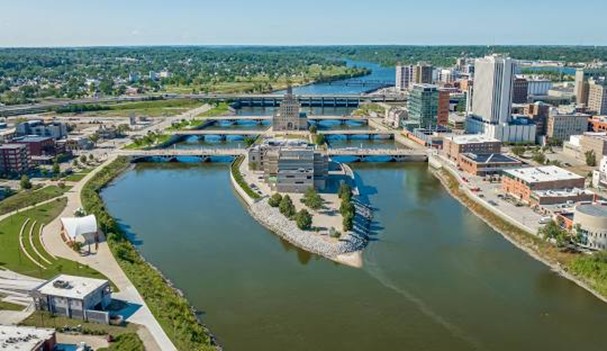
is a city in and the county seat of Linn County, Iowa, United States. Cedar Rapids, Iowa is known for its manufacturing, corn processing, and food and beverage industry. It’s also known as the City of Five Seasons. The population was 137,710 at the 2020 census, making it the second-most populous city in Iowa. The city lies on both banks of the Cedar River, 20 miles (32 km) north of Iowa City and 128 miles (206 km) northeast of Des Moines, the state’s capital.
Cedar Rapids is the economic hub of Eastern Iowa, located at the core of the Interstate 380 corridor.[10] The population of the three-county Cedar Rapids metropolitan area, which includes the nearby cities of Marion, Robins and Hiawatha, was 276,520 in 2020. The Cedar Rapids metropolitan area is also part of a combined statistical area with the Iowa City metropolitan area.
Cedar Rapids is broken into 4 quadrants. North East, North West, South East and South West as defined by the Cedar River and 1st Ave. North of 1st Ave and East of Cedar River is the North East Quadrant. South of 1st Ave and East of Cedar River is the South East Quadrant. North of 1st Ave and West of Cedar River is the North West Quadrant and South of 1st Ave and West of Cedar River is the South West Quadrant.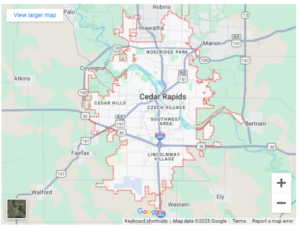


Neighborhoods
There are twelve active neighborhood associations in Cedar Rapids. The neighborhoods nearest downtown include Wellington Heights and Oakhill Jackson in the southeast quadrant and Moundview in the northeast quadrant. Also farther north in the northeast quadrant are Noelridge Park and Kenwood Park, which was independent until it was incorporated into the Cedar Rapids city limits. The boundaries of Kenwood are 32nd Street to Oakland Road to Old Marion Road to C Avenue to 40th Street then 1st Avenue between 40th street and 32nd Street.[51]
In addition to the neighborhood associations in Cedar Rapids, there are many informal, unofficial neighborhoods, such as Bowman Woods, Vernon Heights, Stoney Point, Kingston Village, New Bohemia (NewBo) and Wilderness Estates.
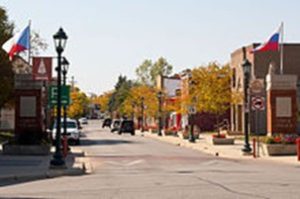
Czech Village is located along 16th Avenue SW, south of the Cedar River. It is home to such Czech-themed businesses as The Czech Cottage, Sykora Bakery, and White Lion Treasures.
Visit Cedar Rapids Businesses >
Homes available in Cedar Rapids, IA >

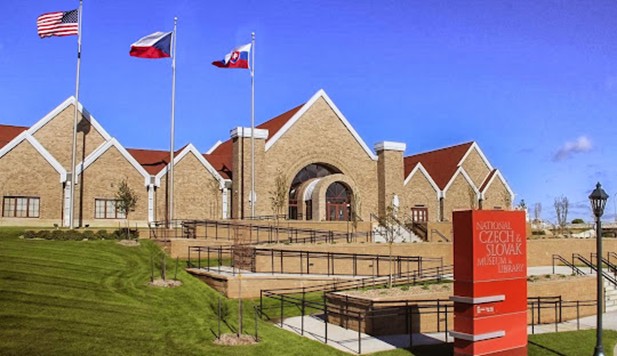
The National Czech & Slovak Museum & Library is one of Cedar Rapids’ major tourist attractions. The museum’s main building was directly on the river and was badly damaged by the 2008 floods. After the flood the museum moved a few blocks to Inspiration Place SW. The Bohemian National Cemetery is located nearby.
In 2024, a new astronomical clock was built, the opening was attending by Czech President Petr Pavel and his wife Eva Pavlová and Slovak President Peter Pellegrini.[52]
Cedar Rapids History
Early history
The location of present-day Cedar Rapids was in the territory of the Fox and Sac tribes at the time of European American settlement.
The first settler on the site of the future city was Osgood Shepherd, who built a log cabin (which he called a tavern) in 1837 or 1838 next to the Cedar River (then known as the Red Cedar) at what is now the corner of First Avenue and First Street Northeast. Shepherd was a squatter who claimed the land without legal title and also a reputed ne’er-do-well, who, if he was not a horse thief himself, definitely consorted with them. Early on, it appears that he “jumped the claim” of another squatter, Wilbert Stone, who had built a cabin and platted out a town, some distance south of Shepherd’s cabin, that he called Columbus. Shepherd drove Stone across the river, claiming that Stone had built his cabin on Shepherd’s land, then sold Stone’s cabin to a buyer named Hull. Shepherd later tried the same tactic with perhaps the first settler on the west side of the river, Robert Ellis, but Ellis happened to be chopping wood at the time and warned that someone would be dead if Shepherd did not retreat.[11]
The true founders of the city were George Greene, Nicholas Brown, and a few others. Brown had experience as a miller and Greene had surveyed much of eastern Iowa,[12] so both saw the value of the spot Shepherd had claimed. It was right next to the rapids—a prime spot to build a mill—the last set of rapids on the river before the Cedar fed into the Iowa River, meaning that goods milled on the spot could be carried by boat down river to the Mississippi. In 1841, they formed a partnership that bought out Shepherd’s claim and platted out a town they called Rapids City. Brown immediately constructed a primitive dam and then built the town’s first mill. His crude dam soon washed away, prompting Greene to induce Alexander Ely, an engineer from Michigan, to build a proper dam that created a mill race capable of powering several mills.[13]
At this time, the city was confined to the east side of the river. The west bank soon contained a village named Kingston for resident David King who early on operated a rope ferry across the river.
The town was formally incorporated by the Iowa State Legislature on January 15, 1849[14] as Cedar Rapids, named for the rapids in the Cedar River (the river itself was named for the large number of red cedar trees that grew along its banks).[15] The population was less than 400.[16]
During the 1850s, Cedar Rapids grew in size, and it was during this decade that the Czech population became substantial; when the town was reincorporated in 1856, a quarter of its roughly 1,600 inhabitants were Czech immigrants.[17] The availability of cheap land in the new state of Iowa happened to coincide with the Revolutions of 1848 in the Austrian Empire that caused a large number of Czechs to flee their homeland and emigrate to the U.S. In 1851, the institution that eventually become Coe College was founded. In the same decade, there were attempts by local leaders to improve the city’s access to distant markets, first through purchase of a steamboat (aptly named Cedar Rapids) and ultimately through investment in a railroad. The first locomotive rolled into town on June 15, 1859.[18]
Railroads were an important factor in the development of the state and the growth of cities along the rail lines. By the end of the 19th century, the 23rd largest state was the fifth largest in track mileage.[19]
In this same decade, “Major” John May, an inventor and land speculator, purchased the island (now called “May’s Island“) situated between Cedar Rapids and Kingston with the intention of founding a town he called May Island. When that scheme proved impractical due to the island’s tendency to flood, he conceived the idea of making his island the center of a larger city that spanned the river and convinced the state legislature to officially name the land he had bought there, just south of Kingston, “West Cedar Rapids.”[20]
Cedar Rapids annexed the community of Kingston in 1870 and constructed an iron bridge across the river along the line of the current Third Avenue bridge.
The economic growth of Cedar Rapids increased in 1871 upon the founding of the Sinclair meatpacking company. The plant allowed for year-round meatpacking because ice could be harvested from the Cedar River in winter to chill an icehouse, and within a few years it became one of the largest factories of its kind in the country, employing 400 people.[21] In 1873, the oatmeal mill that ultimately became the flagship operation of the Quaker Oats Company – and the largest cereal mill in the world – was built.
In 1909, the city acquired May’s Island for the purpose of making it the seat of government; then, as now, there were ill feelings between east- and west-siders in Cedar Rapids, and the city’s leaders hoped that putting City Hall in the “neutral territory” of the island would help ease tensions. In 1919, the residents of Linn County voted to move the county seat from Marion to Cedar Rapids, partially because Cedar Rapids had offered to donate the southern third of the island as a site for a new county courthouse and jail.
Major Employers in the Cedar Rapids Area
Collins Radio Company/Rockwell Collins/Collins Aerospace
Arthur A. Collins founded Collins Radio Company in 1933 in Cedar Rapids, Iowa. It designed and produced both shortwave radio equipment and equipment for the AM radio broadcast industry. Collins supplied the military, the scientific community, and the larger AM radio stations with equipment. Collins provided the equipment to establish a communications link with the South Pole expedition of Rear Admiral Richard E. Byrd in 1933.
In 1936, Collins had begun production of the 12H audio console, 12X portable field announcers box, and the 300E and 300F broadcast transmitters. Throughout World War II, the 212A1 and 212B1 replaced the 12H design. Collins became the principal supplier of radio and navigation equipment used in the military.
In the postwar years, the Collins Radio Company expanded its work in the communications field, while broadening its technology into flight-control instruments, radio-communication devices, and satellite voice transmissions. Collins Radio Company provided communications for the United States’ role in the Space Race, including equipment for astronauts to communicate with earth stations and equipment to track and communicate with spacecraft. Collins communications equipment was used for Projects Mercury, Gemini and Apollo. In 1973, the U.S. Skylab program used Collins equipment to provide communication from the astronauts to earth.
More Information >
Source: Cedar Rapids, Iowa – Wikipedia
Churches in Cedar Rapids, IA
Homes available in Cedar Rapids, IA